

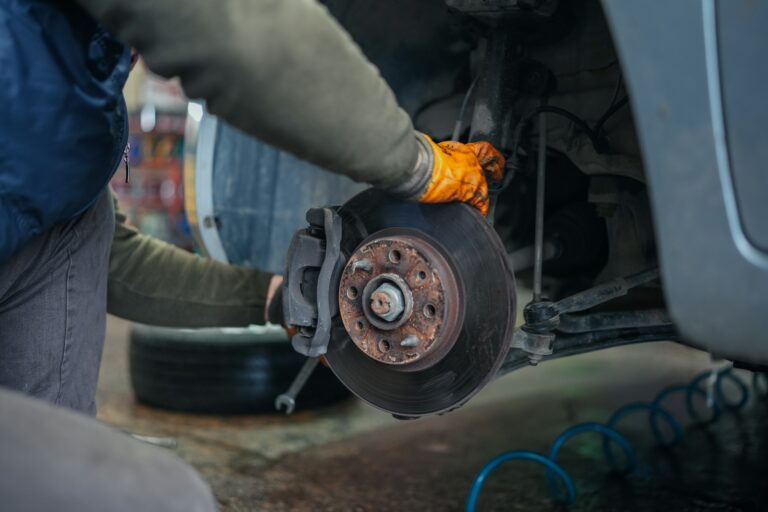
When you ask for a brake quote, one of the first questions is whether you need new pads only, or new pads and rotors. The answer changes the price, so it helps to know what each option means before the mechanic arrives. Some drivers can get away with pads alone. Others will waste money if they skip the rotors.
Here is how to tell the difference, what happens if you put new pads on worn rotors, and what to have ready so your quote comes back accurate the first time.
Pads vs. Rotors: What Each Part Does
Your brake pads are the friction blocks that squeeze against the rotor when you press the pedal. They are built to wear down, so they get replaced most often. The rotor is the metal disc behind the wheel that the pads clamp onto. It wears too, but much more slowly, and many rotors last through one or two sets of pads.
Because the two parts work as a pair, the condition of the rotor decides whether new pads will work properly. A fresh pad needs a smooth, even surface to grip.
When Pads Only Is Usually Enough
New pads on the existing rotors is often the right call when:
- The rotors are still above the minimum thickness stamped on them (usually marked “MIN TH”)
- The rotor surface is smooth, without deep grooves, lips or heavy rust pitting
- You feel no shaking or pulsing in the steering wheel or pedal when you brake
- The noise is a light squeal from the wear indicator, and it only started recently
- The pads were replaced on schedule and never wore down to the metal backing
In that situation, replacing the pads restores full stopping power and the rotors keep doing their job.
When You Need Pads and Rotors
Plan on new rotors along with the pads if you notice any of these:
- Grinding or scraping: the pads have likely worn to metal and cut into the rotor. See our guide to strange brake noises.
- Shaking or a pulsing pedal when braking: usually a sign of uneven rotors. Here are 6 common causes of a car shaking when braking.
- Deep grooves, a raised lip on the outer edge, or blue heat spots on the rotor face
- Rotors at or below minimum thickness, measured during the inspection
- Cracks in the rotor or its cooling vents
- The rotors have already been through one or two sets of pads
If you are not sure, our post on when to replace brake rotors covers each warning sign in more detail.
Quick Comparison
| Pads only | Pads and rotors | |
|---|---|---|
| Best when | Rotors are smooth and above minimum thickness | Rotors are grooved, uneven, thin or damaged |
| Typical signs | Light squeal from the wear indicator | Grinding, shaking, pulsing pedal |
| Cost | Lower | Higher, since rotors are added parts |
| Risk of skipping rotors | Low if rotors check out | Noise and shaking come back, pads wear faster |
What Happens If You Put New Pads on Worn Rotors
It can be tempting to save money by replacing only the pads. When the rotors are worn, that usually backfires:
- Less contact: a grooved or uneven rotor only touches part of the new pad, so stopping power is lower until the pad wears to match the damage.
- Noise comes back: squealing or grinding can return within weeks.
- Shaking stays: new pads do not fix uneven rotors, so the pulse in the pedal or steering wheel continues.
- Pads wear out faster: rough rotors chew through pad material, and you end up paying for another brake job sooner.
Can Rotors Be Resurfaced Instead?
Sometimes. Resurfacing (also called “turning” or “machining”) shaves a thin layer off the rotor to make it smooth again. It only works if the rotor will still be above its minimum thickness afterward. Many modern rotors are fairly thin from the factory, and new rotors are often close in price to the labor of resurfacing, so replacement is frequently the better long-term choice.
Why Phoenix Drivers Often Need Rotors Sooner
Arizona driving is hard on brakes. Summer heat means rotors start hotter and take longer to cool, stop-and-go traffic on the I-10, the 101 and the 202 adds repeated heat cycles, and long downhill grades like I-17 coming back from Flagstaff can overheat pads and rotors quickly. Heat is what wears rotors unevenly, so a rotor in the Valley may not last as long as the same part in a milder climate.
A Few Rules Every Brake Job Follows
- Pairs on the same axle: pads (and rotors, if needed) are always replaced on both the left and right side together, so the car stops evenly.
- Front brakes wear faster: the front axle does most of the stopping, so front pads usually wear out before the rears. Our guide on how long brake pads last explains why.
- Front and rear are separate jobs: needing new front pads does not automatically mean the rears are due, and the other way around.
What to Have Ready Before You Ask for a Quote
A few details make your quote far more accurate:
- Year, make and model (trim helps too, since brake sizes can differ)
- Which axle you think needs work: front, rear or both
- What you hear or feel: squealing, grinding, shaking, a soft pedal
- Roughly when the brakes were last done, and the mileage
- Whether you want a price for pads only, pads and rotors, or both
How We Handle It at Your Home or Work
With mobile brake repair, we come to your driveway or office, take the wheels off and measure the rotors before any work starts. If pads alone will do the job, we tell you. If the rotors need replacing, we show you why and confirm the price first, so there are no surprises. We serve Phoenix, Mesa, Tempe, Scottsdale, Chandler, Gilbert, Glendale, Queen Creek and the rest of our service areas.
Frequently Asked Questions
Do I always need new rotors with new brake pads?
No. If the rotors are smooth and above minimum thickness, new pads alone are fine. Rotors are needed when they are grooved, uneven, too thin or damaged.
How do I know if my rotors are bad without taking the wheel off?
Grinding noises, a pulsing brake pedal and a steering wheel that shakes when you brake are the most common clues. A visual check through the wheel can show deep grooves or a raised edge, but measuring the thickness is the only way to be sure.
Why did my quote include both options?
Until the wheels are off and the rotors are measured, it is not always possible to know which job you need. Quoting both gives you the full picture up front, and the final choice is confirmed on site before any work begins.
Is it safe to drive while I wait for a brake appointment?
A light squeal from the wear indicator is a warning, not an emergency, so book soon. Grinding, shaking that gets worse, a soft pedal or a brake warning light mean you should stop driving and have the car checked where it is.
🚗 Not Sure If You Need Rotors? Let Us Check
Get a straight answer before you pay for anything. Book with Nate for a free quote, or call (602) 741-3529, and we will come to your home or work anywhere in the Phoenix metro. 🛠️